
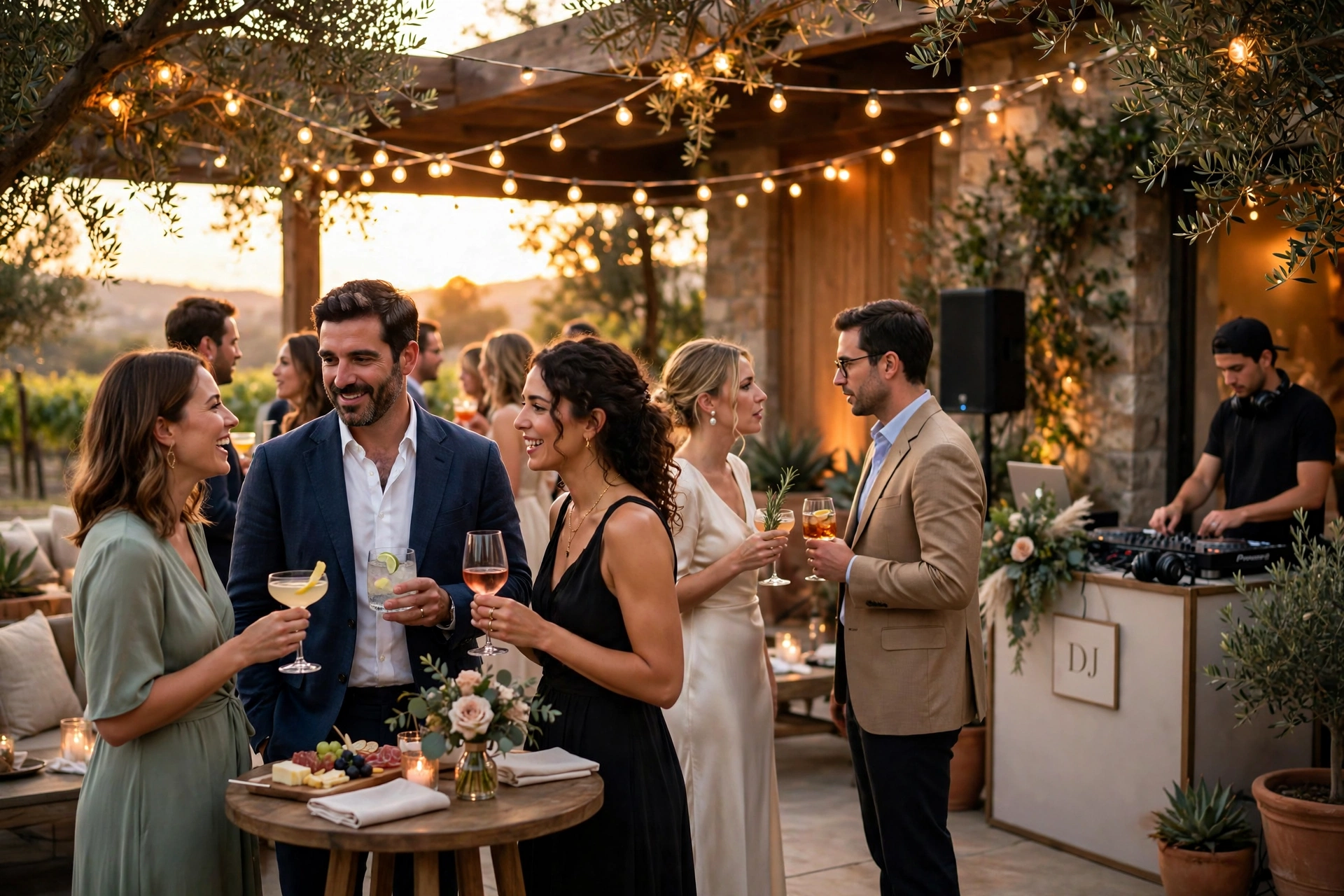
Everybody thinks the job is the music. It is not. The music is the easy part. Anybody with a laptop can play good songs. The job is reading the room, and after twenty years behind the decks, I can tell you the music was never the hard part.
The job is the room.
Reading the room is the entire profession, and no playlist can do it. It looks like nothing. A guy behind a table, nodding along. Really it is air traffic control: two hundred people, sorted into groups, their next move predicted, the music adjusted before they know they want it adjusted.
I have been DJing since 2005. Clubs, bars, weddings, a residency at Phoenix Hill Tavern back when they billed me as “DJ Sam The Tiki Man” (a name I hated then and hate now). Twenty-plus years of watching rooms taught me more than any mixing tutorial. Let me show you what the skill looks like, one hypothetical night at a time.
Call the couple Maya and Devon. They never existed. The night I am about to walk you through has happened a hundred times, in a hundred ballrooms. The names are made up. The reads are not.
6:30 PM. Cocktail hour. The room gives you the menu.
I am set up in the corner, background music playing, and I am not watching my laptop. I am watching the people, reading the room before the room knows there is anything to read.
First read: the generations. How many are over sixty? How many are under thirty? A room that is 70 percent family over fifty gets a completely different night than a room that is 70 percent college friends. Neither is better. But they are different parties, and the DJ who does not notice will play the wrong one.
Second read: the clusters. People tell you everything with their feet. The group camped by the bar will need the dance floor to earn them. The table of aunts already laughing too loud at 6:30 will be my early shift, the first ones out there, who give the shy people permission. The groomsmen doing shots in the corner are a time bomb, and I mean that with love. They will either be the best dancers in the room or a problem to route around. Manageable either way if I see it coming at 6:30 instead of 9:30.
Third read: the couple. Maya and Devon are working the room, glowing, stopping at every table. Good. The formal stuff will run on time. A couple that vanishes for forty minutes of photos tells me the room will cool off, and I will need a plan to warm it back up. Just data.
I learned this the slow way. Early on I spent cocktail hour beatmatching background music nobody was listening to, feeling very professional. Then my mentor Eric, the office manager who hired me at Complete Weddings, watched me do it and said the only thing that mattered: “Stop mixing. Start looking.” Best advice I ever got in this business.
7:15 PM. Dinner. The quiet tells you things too.
Dinner is the most underrated part of the night, because everyone thinks nothing is happening. I am just listening instead of watching.
The volume of the room during dinner previews the volume of the dance floor later. A loud dinner means the floor will ignite fast, and I need to be ready earlier than the timeline says. A quiet dinner means a slow-burn crowd, and I will need to build longer and be patient.
Then there are the pockets. Table twelve is roaring. Table four is silent. Speeches are running long and I can feel the room’s attention fraying. A room that sat through forty-five minutes of speeches needs the exact opposite energy the second dinner ends. A release valve, not a slow build.
And my favorite read of the night: grandma. Find the oldest person in the room who is clearly having a good time. If she is bouncing in her chair during dinner music, you have a dancing family. If her arms are crossed, the older generation will need coaxing. Grandmas are the canary in the coal mine of a wedding reception. Never been wrong about this.
(I am also listening to the room itself, the actual acoustics, because a room that swallows sound needs a different approach than one that bounces it. I wrote a whole piece about ceremony sound, the part nobody thinks about until it squeals. Same principle all night: the room is an instrument, and you have to tune to it.)
8:00 PM. The doors open. Reading the room in three songs.
Something most couples never realize: the first three songs of open dancing are not the party. They are tests.
I am not playing what I think the room will love. Instead, I am playing three different doors and watching which one opens. I might open door one with Motown, something the older crowd cannot resist. For door two I reach for a 2000s throwback, the millennial sweet spot. Then door three gets something current. I watch the floor like a scientist. Who moves first? Who stays seated but starts swaying? And who gets up for a drink the second the beat drops, which is also data, because leaving is a vote too.
The rule I live by: watch feet, not faces. Faces lie at weddings. Everyone is smiling, because that is the assignment. Feet do not lie. Tapping feet mean the song is working even if nobody is dancing yet. Still feet mean the song is wallpaper, and I have about ninety seconds before that group checks out for the next twenty minutes.
Maya and Devon opened with a song they loved, some indie track with personal meaning. Perfect for the first dance, where it belonged. Then I took over, because the first dance is theirs and the rest of the night is everybody’s. That is a distinction a lot of couples struggle with, and it is the DJ’s job to hold the line kindly.
By the end of song three, I have my map. Now the real night starts.
9:00 PM. Peak. Reading the room at full volume.
This is the part that looks like magic and is actually just attention. A packed floor has a pulse, and the pulse changes every few minutes.
When the energy is climbing, song to song, hands going up, the circle forming, I do not touch it. I stay in the lane. Same tempo family, same energy, no sharp turns. The biggest amateur mistake in DJing is getting bored before the crowd does. The floor is screaming and the DJ thinks, “Let me switch it up,” and the floor dies. I have watched it happen a hundred times. When it is working, your only job is to not break it.
But the floor also tells you when it needs air. The dancing gets a little less committed. People start doing that half-dance where they are mostly talking. The bar line gets longer. That is not failure. That is a room asking for a breather, and a good DJ gives it one on purpose: a singalong, a slower groove, something everybody knows the words to. Rest the room without losing it. Then build again.
The other peak-hour read: the requests. Requests are not interruptions. They are the room handing you its data directly. Three different people in twenty minutes ask for 90s hip-hop, and the room is telling me what it wants. I treat that as a directive, not a suggestion. My policy: if I have it, I will play it. Sometimes it does not fit right now, so I hold it and drop it twenty minutes later when the door is open. The guest thinks I forgot. I was waiting for the room to be ready, because reading the room means knowing the difference between a no and a not-yet.
10:00 PM. The wobble: reading the room when the floor dips
Nobody tells couples this: every dance floor dips. Every single one. Around the two-hour mark, the energy drops. People are tired. The older crowd starts leaving. New DJs panic at the wobble. Veterans expect it.
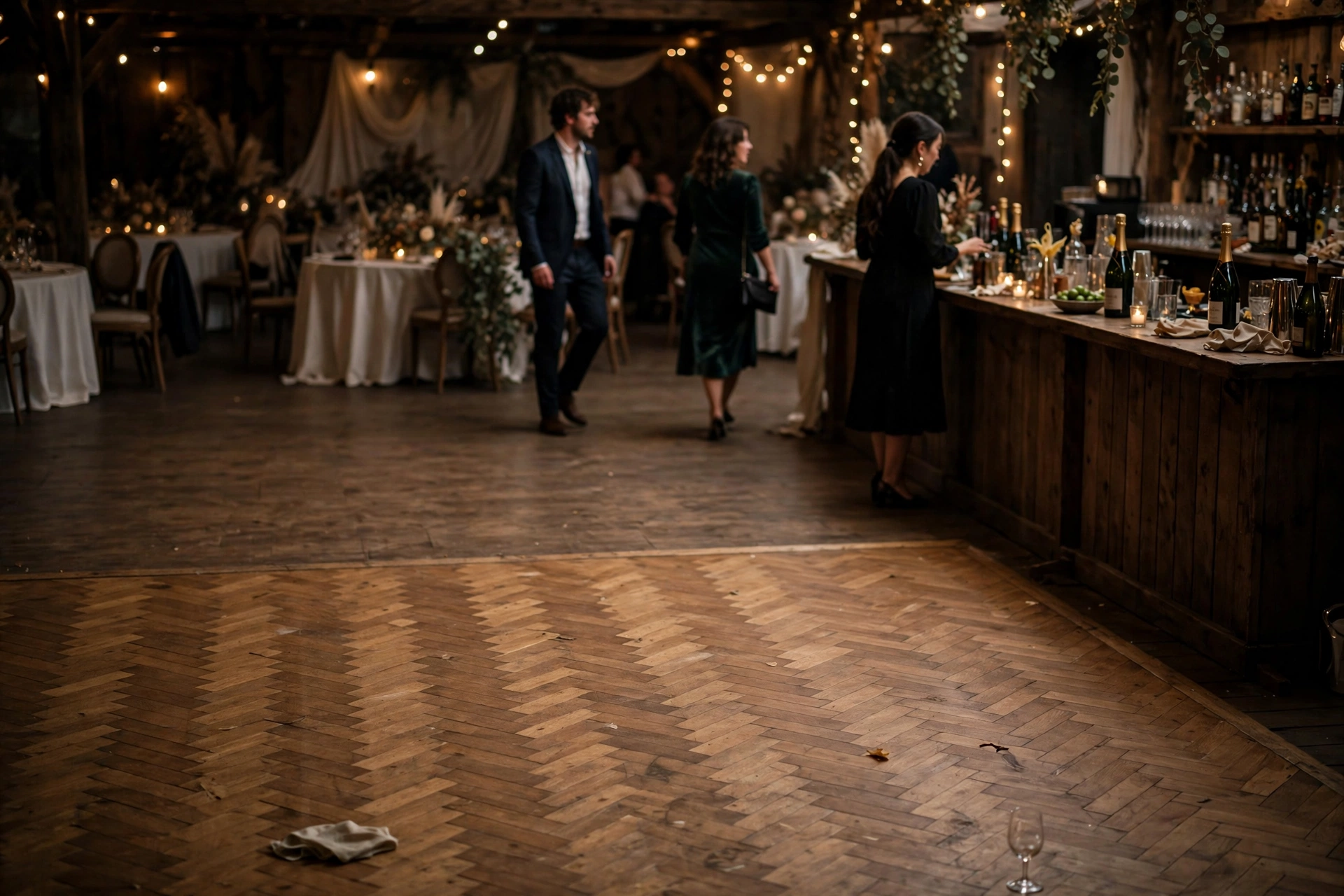
The read that matters here is the bar line. The bar is a thermometer. If the line is long but people are still bouncing and singing along from the bar area, the room is fine, it just needs a minute. If the line is long and the bar area has gone quiet, people are winding down, and I have a decision: rally, or ride the glide path.
A tired room cannot be shouted back to life. The save is a different door. Change the generation: if the last hour was all young-crowd music, play the song that brings the aunts and uncles back. Fresh legs are fresh energy. Change the texture: from electronic to live-band feel, from new to nostalgic. Novelty wakes people up faster than volume.
And sometimes the read is: let it dip. If Maya and Devon are slow dancing in the corner, glowing, surrounded by their twenty closest people, and the floor is half full but happy, that is not a problem. That is a wedding. The DJ who cannot tell a dying floor from a content room will thrash the night trying to fix something that is not broken. Twenty years of reading the room teaches you which is which.
The last song. The closer is not for the dancers.
Last read of the night, and the most important one. The last song is not for the people still dancing. It is for the couple.
By now I have been watching Maya and Devon all night. Are they the singalong-into-the-microphone type, wanting every remaining guest screaming the words? Or the slow-dance-in-the-middle-of-their-people type? The room tells you too. A rowdy, still-packed floor wants the anthem. A tender, winding-down room wants the slow one.
Get the last song right and the whole night retroactively feels perfect. People do not remember the middle of the reception. They remember the peak and the ending. So the last three minutes get more thought than any other three minutes of the night.
When it lands, when Maya is crying laughing and Devon is spinning her and the remaining forty people are swaying with their phone flashlights up, that is the whole job. That is what the six hours of reading was for.
The bottom line
Maya and Devon never existed. But every read in their night was real. The generations, the grandma test, the three diagnostic songs, the bar thermometer, the wobble, the closer. That is the actual skill set, and it is why a DJ costs more than a playlist. You are not paying for songs. You are paying for six hours of someone watching your room.
A playlist plays music at your guests. A DJ plays music with them, reading the shift in the air before anyone else feels it, adjusting before anyone knows an adjustment was needed. That is the job. Reading the room has always been the job. The decks just make it look like it is about the music.
DJ Sam I Am 502 is a Louisville wedding DJ with Complete Weddings + Events. Still building your music plan? Start with the songs that should never touch a speaker: The Do-Not-Play List: Songs to Ban From Your Wedding. Ready to talk about your night? Request your date here.

DJ Sam I Am 502 is a Louisville wedding DJ with Complete Weddings + Events. He has spent 20 years behind the decks reading dance floors, keeping timelines on track, and making sure the music never gets in the way of the moment.
Leave a Reply