Ask a bride what she’s worried about for her wedding and she’ll say the dance floor. The dress. The flowers. The drunk uncle. She will not say the ceremony sound. Nobody ever says wedding ceremony sound.
And that is exactly why, at roughly 6:18 on a Saturday evening somewhere in Kentucky, a hundred guests are about to watch an officiant’s microphone let out a scream like a teakettle and die in front of everybody.
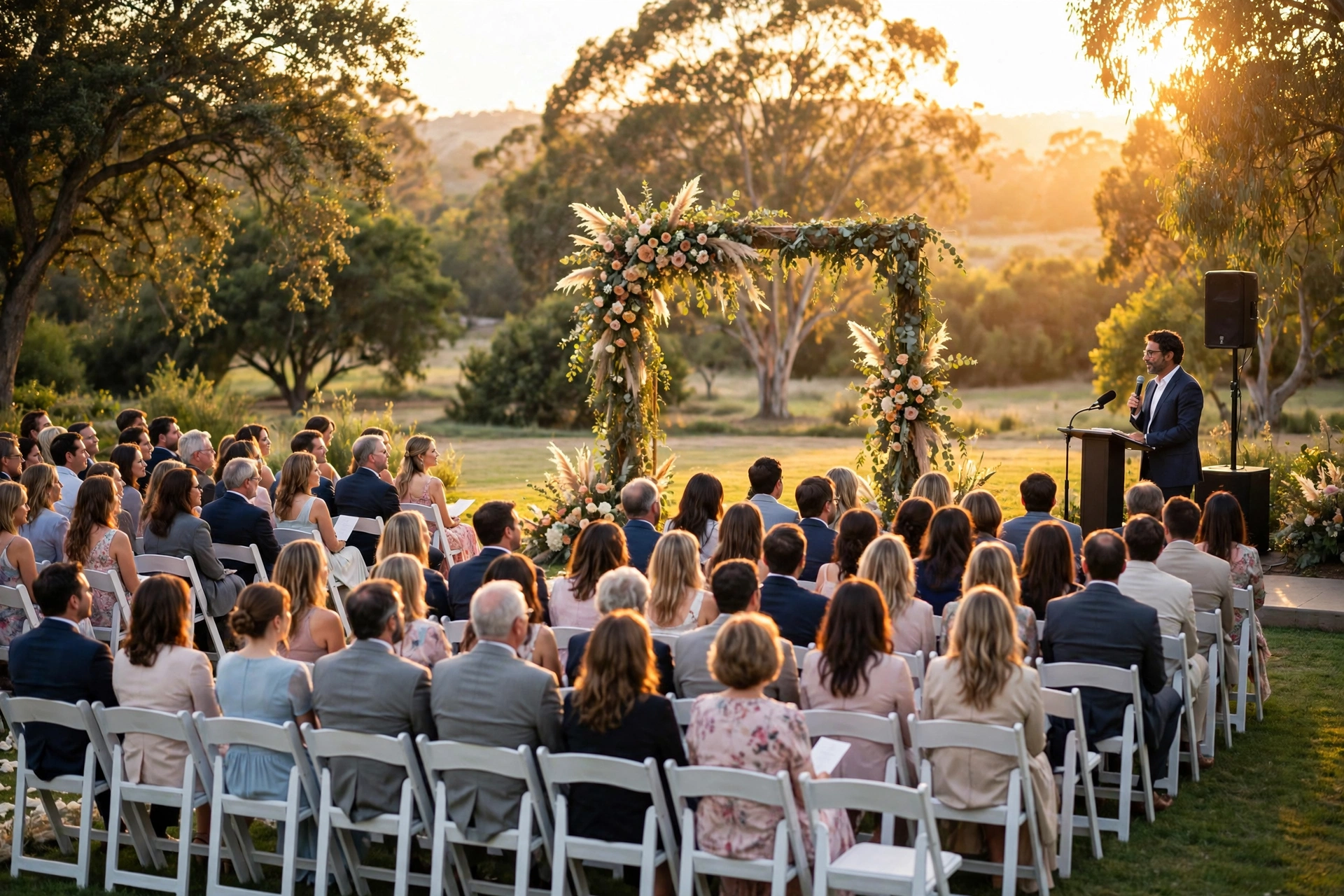
I’ve been DJing weddings since 2005. Twenty-plus years. I can tell you the exact minute in every ceremony where the sound either works or it doesn’t, because I’ve watched it go wrong in every way it can go wrong. So let me walk you through one. A hypothetical wedding. Saturday, 6 PM. Outdoor ceremony, because the weather is pretending to cooperate, and a couple who spent eleven months planning the reception and about eleven minutes thinking about wedding ceremony sound.
Here’s how the next forty minutes go.
5:45 PM: The Setup Nobody Sees
Long before a single guest sits down, the sound for your ceremony is already decided. Not during the ceremony. Right now. In the setup.
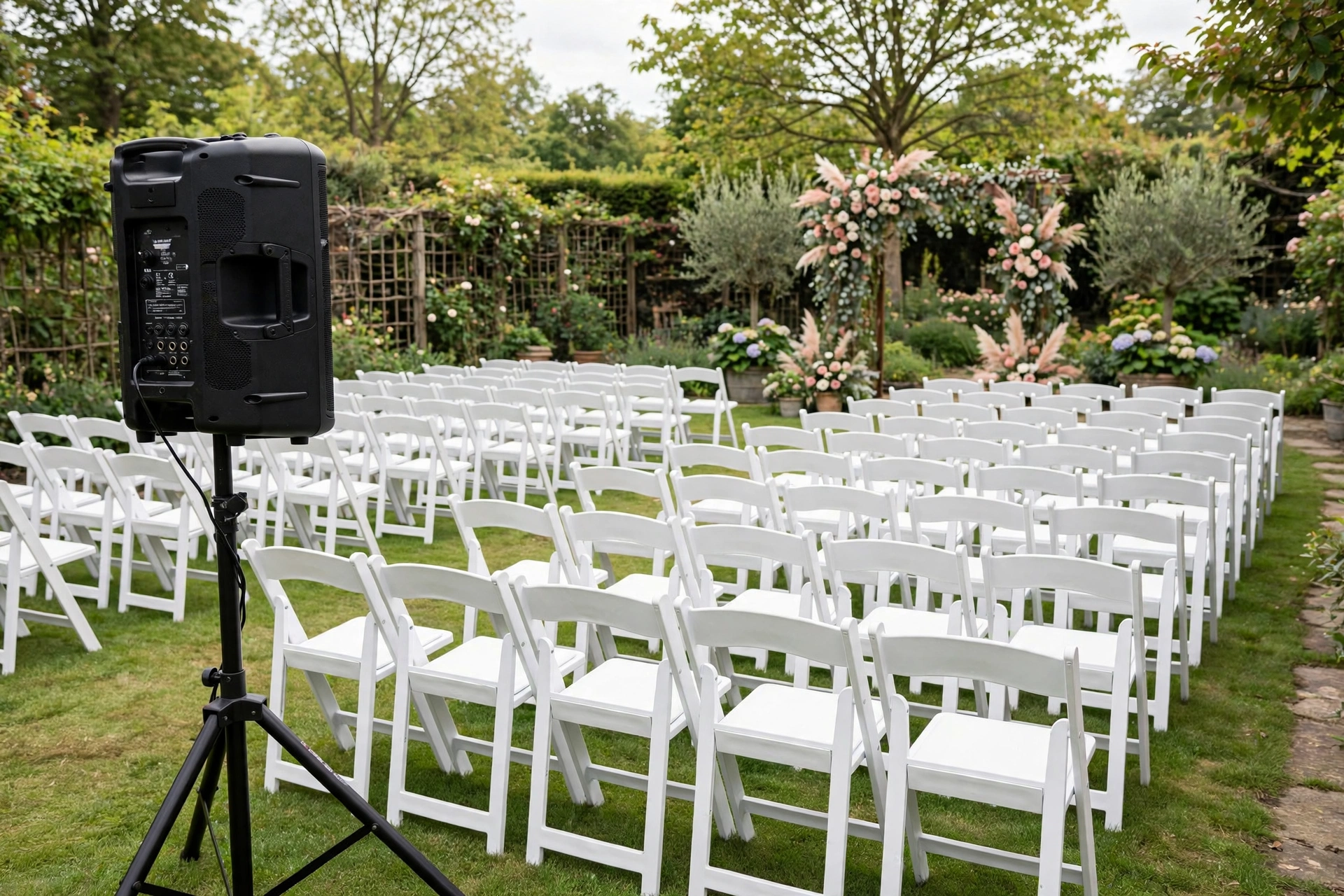
Picture this: one speaker on a stand, off to the side, angled at the guest chairs. Not behind the officiant. Not pointed at the wedding party. At the guests. This is the whole game, and most of the time it’s already lost before the music starts, because somebody put the speaker wherever it was convenient instead of wherever it needed to be.
Here is the one piece of audio science that matters for your wedding: feedback happens when a microphone hears itself through a speaker. That’s it. That’s the squeal. The mic picks up the speaker, the speaker plays it back louder, the mic picks that up, and around we go until everybody in the first three rows is covering their ears. So the speaker goes in front of the mics, facing the crowd. The mics stay behind the speaker’s reach. This is not advanced engineering. It’s furniture placement. But get it backwards and your vows come with a soundtrack of pain.
Then there’s the wind, which is the outdoor ceremony’s other great enemy. Wind doesn’t care about your timeline. It hits the mic and turns your officiant’s beautiful reading into a hurricane warning. The fix is stupidly simple: a foam windscreen on the mic, and a sound person who knows to pull the gain back when a gust rolls through. Five-cent fix. Almost nobody thinks of it until the video comes back sounding like a storm documentary.
6:00 PM: The Seating Music Problem
Guests are arriving. Somebody has to play the seating music, and this is where couples make their first unforced error: they hand the job to whoever is closest. A cousin with a phone. A Bluetooth speaker someone brought from home.
Now picture the actual failure modes, because there are so many and they are all real. The cousin gets a phone call mid-prelude and your string quartet cover of a pop song gets interrupted by a ringtone. A text notification dings through the speaker during the mothers’ seating. The phone’s battery hits four percent during the bridesmaids’ walk. Or my personal favorite: the Bluetooth disconnects, and thirty seconds of dead silence rolls across a hundred seated guests while somebody sprints to the speaker holding a phone like it’s a relay baton.
Ceremony music needs a dedicated device, cued up, on airplane mode, with a full battery, run by a person whose only job for the next forty minutes is sound. If your DJ is handling the ceremony, that’s him. If he’s not, you need to name the human being who is, and “we’ll figure it out” is not a name.
And the volume: seating music is background music. Guests should be able to talk over it without raising their voices. If your guests have to shout their small talk over the prelude, the energy is wrong before the wedding party even lines up. Quiet, warm, present. That’s the target.
6:14 PM: The Processional, or Timing Is Everything
The wedding party is lined up. The coordinator gives the nod. And this is the moment that separates a DJ from a guy pressing play.
Because the processional song has an intro. Most songs do. Thirty seconds of soft piano, or a slow build, or just dead air before the first real note. And if your DJ starts the track the second the doors open, your bridesmaids are walking down the aisle to nothing. Meanwhile the actual good part of the song, the part you picked it for, hits while everyone is already seated and staring at the back of the church doors waiting for you.
The move is to start the song early enough that the good part lands when the bride lands. That means knowing the song. That means having it cued to the right spot, not just hitting play on a playlist and hoping. It also means the DJ is watching the coordinator, not his phone, so when the flower girl freezes halfway down the aisle (she will, it’s adorable, plan for it), he can stretch the moment instead of letting the song run out into awkward silence.
Volume matters here too. The processional should swell. Guests should feel it lift when the bride appears. A flat, timid little track at background volume while the biggest entrance of the day happens is a missed moment you don’t get back.
6:18 PM: The Vows, and the Wedding Ceremony Sound Squeal
Here we are. The minute I warned you about.
The officiant is mic’d. The couple is standing close enough to share the mic. And the vows begin, and the bride, overwhelmed and emotional, speaks at roughly the volume of a librarian shelving books.
This is normal. Brides whisper their vows. Grooms mumble theirs. They are nervous, they are crying, they are trying not to ugly-cry on camera. It is the most human moment of the day, and it is acoustically terrible.
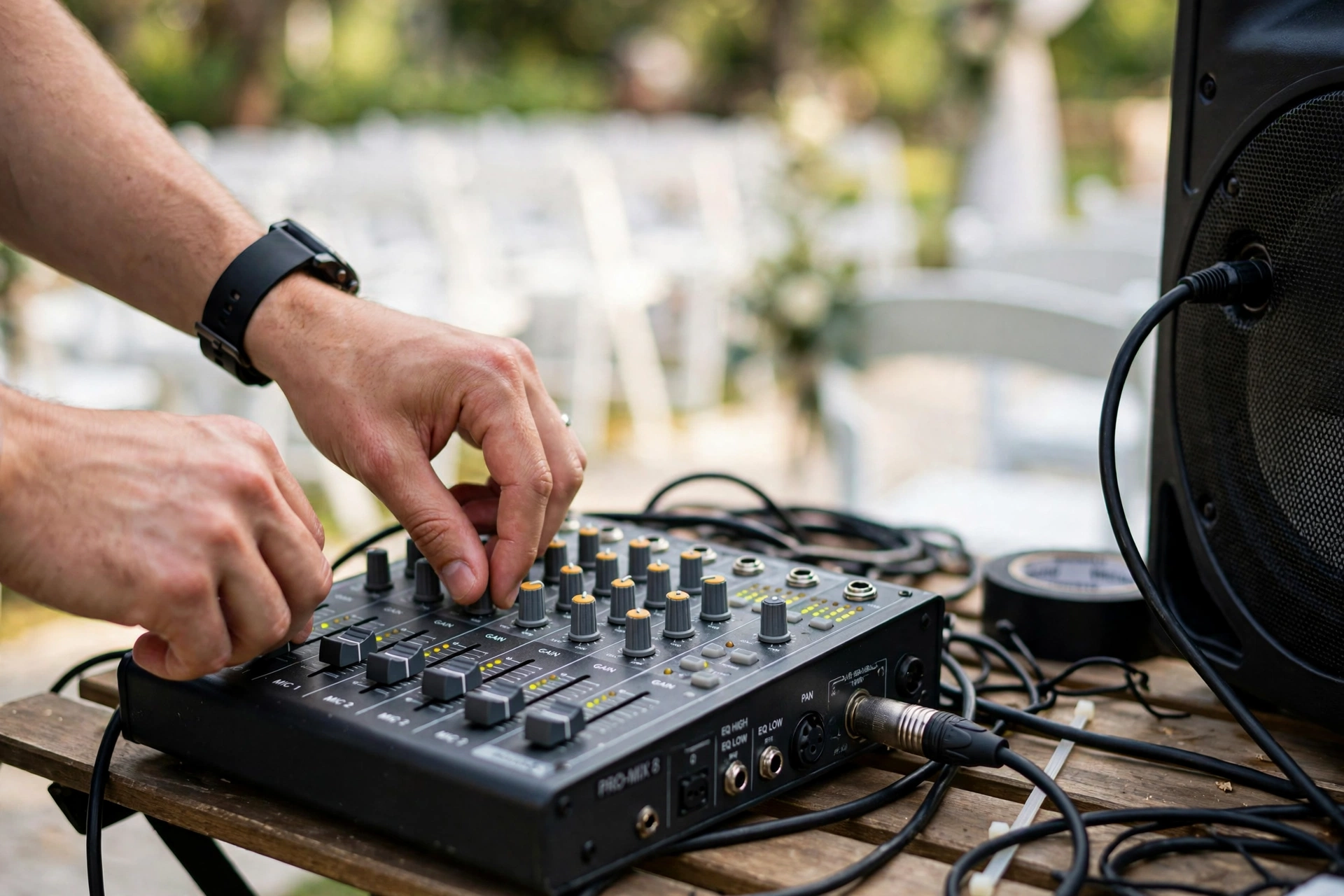
So somebody has to ride the gain. That’s the fader on the mixer that controls how loud the mic is. When the officiant is projecting like a theater kid, you pull it back. When the bride drops to a whisper, you push it up, gently, before the back row loses her completely. This is a live, second-by-second job. It cannot be set and forgotten. A speaker on a stand with nobody touching it is a prayer, not a plan.
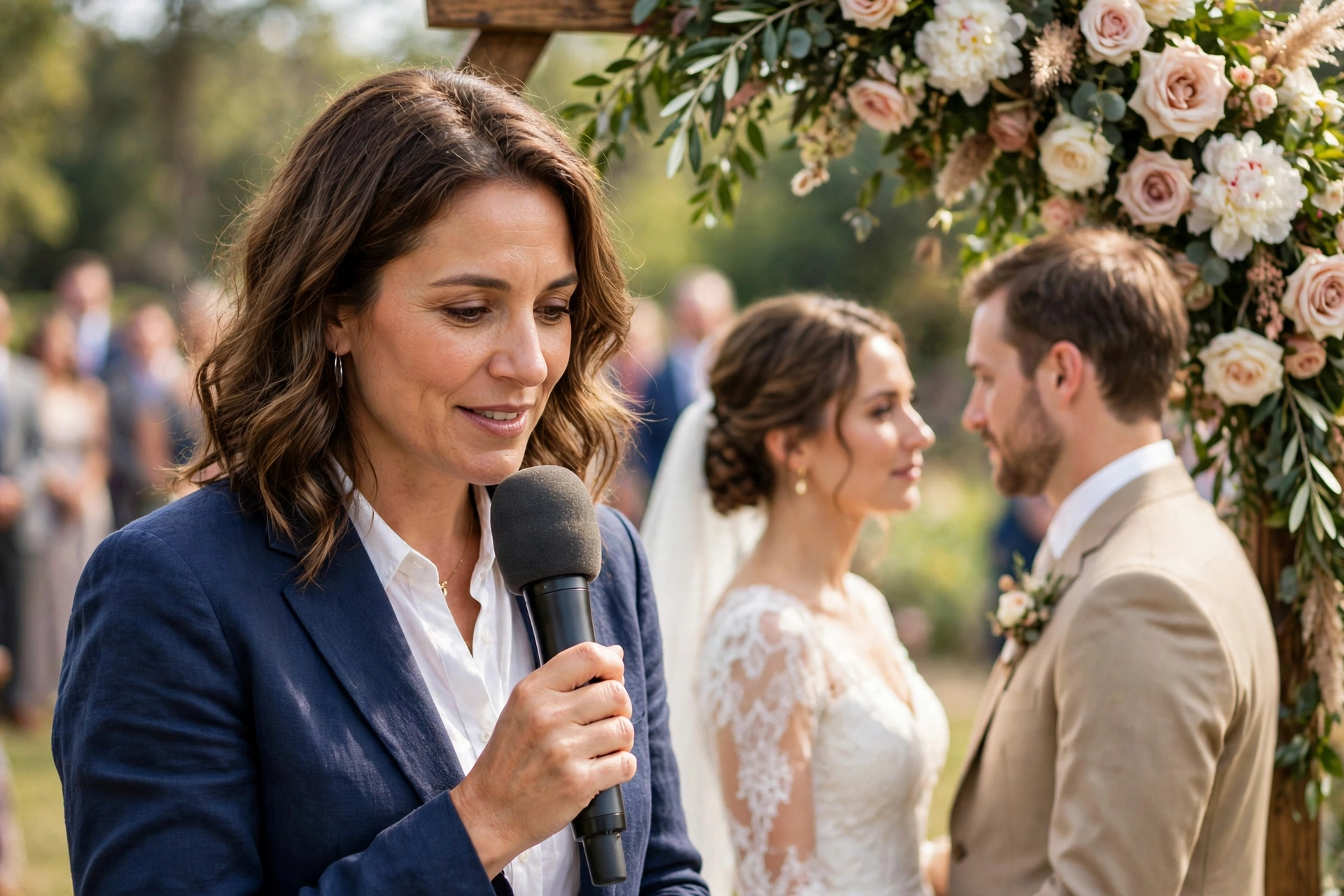
And the squeal? It almost always happens right here, and it happens for the dumbest reason: somebody moved. The officiant takes two steps toward the speaker to get a better angle on the couple. Or a reader grabs the handheld mic and wanders. The mic crosses into the speaker’s zone, hears itself, and screams. In a hypothetical ceremony, the guests laugh nervously. The couple flinches. The videographer’s audio is ruined for the one part of the day that actually needed to be heard.
The prevention is boring and it works: mics stay put, speakers stay in front, and the person running sound is watching the mics like a hawk during the vows instead of checking the reception playlist. Boring prevention. Beautiful vows.
6:24 PM: The Kiss, and Don’t Blow the Landing
“I’m pleased to present, for the first time…” The crowd is already half standing. The kiss happens. Everybody cheers. And this is the easiest moment in the entire ceremony to fumble, because the recessional song has to be ready RIGHT NOW.
Not in ten seconds. Not after the DJ finds it. Now. The energy of that cheer has a half-life of about fifteen seconds, and if the recessional music isn’t already cued and swelling underneath the applause, the moment deflates while somebody scrolls. I’ve seen it. The couple is beaming, the guests are clapping, and there’s just… silence. Then a song starts, quietly, apologetically, like it wasn’t invited.
The fix: the recessional track is loaded and cued before the vows even start. Finger on the fader. When the kiss lands, the music lifts with the cheer. The couple walks out on a wave instead of into a vacuum. Same forty minutes. Completely different memory.
After the Ceremony: Five Questions That Prevent All of This
You don’t need to become a wedding ceremony sound engineer. You need to ask five questions, ideally months before the wedding, of whoever is running your ceremony sound.
1. Who is running sound for the ceremony, and is that their actual job? “My cousin will handle it” is not an answer. You want a name and a plan.
2. Where do the speakers go, and who is mic’ing the officiant? If nobody can answer the speaker placement question, the squeal is already scheduled.
3. What’s the backup if a mic dies or the wind picks up? A spare mic, a windscreen, a person who knows what gain is. Pick all three.
4. How is the processional music being played? Dedicated device, cued up, airplane mode, full battery. If the answer involves someone’s personal phone with notifications on, fix it now.
5. Can the back row hear the vows? This is the whole test. If grandma in row eight can’t hear “I do,” nothing else about the ceremony sound worked.
Ask those five about your wedding ceremony sound, and you skip every disaster in the timeline above. Skip them, and you’re rolling dice on the forty minutes your guests will actually remember best. Funny thing about ceremonies: nobody remembers the seating music. Everybody remembers the squeal.
Don’t be the squeal wedding.
DJ Sam I Am 502 is a Louisville wedding DJ with Complete Weddings + Events. Worried about guests hijacking your music at the reception? I wrote a whole survival guide on handling requests without throwing anyone under the bus: The Song Request Survival Guide. Ready to talk about your night? Request your date here.

DJ Sam I Am 502 is a Louisville wedding DJ with Complete Weddings + Events. He has spent 20 years behind the decks reading dance floors, keeping timelines on track, and making sure the music never gets in the way of the moment.
Leave a Reply